‘European research networks to facilitate drug research in children’ has been published in the British Journal of Clinical Pharmacology. Paediatric drug development faces several barriers. These include fragmentation of stakeholders and inconsistent processes during the conduct of research. This review summarises recent efforts to overcome these barriers in Europe. Two exemplar initiatives are described.…
In a conventional clinical trial, adult or paediatric, typically half of the participants receive the drug under investigation and half receive placebo or standard of care. If there are many trials in a disease area, it can be hard to find enough patients for all the trials taking place at a given time. Trials may…
“The conect4children (c4c) Consortium: Potential for Improving European Clinical Research into Medicines for Children” has been published in Pharmaceutical Medicine. Clinical trial scientists and their teams, for several decades, have partially succeeded in improving ways on how paediatric trials are conducted. In 2007, the European Union recognised the need to facilitate development of medicines…
“Path towards efficient paediatric formulation development based on partnering with clinical pharmacologists and clinicians, a c4c expert group White paper” has been published by British Journal of Clinical Pharmacology. Despite regulatory requirements and incentives, paediatric formulations still lag behind adult formulations for medicines used in both adults and children. This is largely due to…
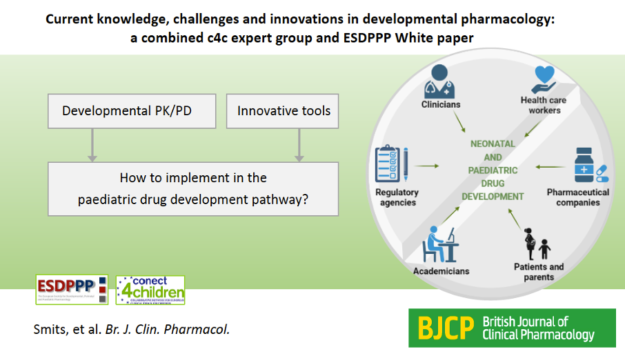
“Current knowledge, challenges and innovations in developmental pharmacology: a combined c4c expert group and ESDPPP White paper” has been published by British Journal of Pharmacology A new paper from c4c experts provides a summary of current evidence and provides scientific insight and suggestions to incorporate the latest knowledge on developmental pharmacology and innovative techniques…
What is conect4children? [Video] Better medicines for babies, children and young people Thanks to the joint forces of both academic and industry partners, the Pan-European network, c4c aims to accelerate the development of innovative medicines for the entire paediatric population. c4c listens to the voices of children, young people, and their families, and is committed…
First c4c Multi-Stakeholder Meeting on Paediatric Inflammatory Bowel Disease (IBD) More than 100 stakeholders from academia, industry, regulators and patients/patient associations attended our first Multi-Stakeholder Meeting (MSM) on April 14 and 15, 2021. Background MSMs are designed to facilitate discussion and interaction among relevant stakeholders on the development of medicines in the best interest of children…
Strategic feasibility expert advice groups One of the key activities of c4c is to set up an advice process to facilitate expert advice, (Strategic Feasibility Advice) to c4c industry and academic beneficiaries on any aspect of a paediatric drug research and/or development project (e.g., study design including methodology, assistance with regulatory responses). More than 300…
Patient and Public Involvement (PPI) The voice of the patient in clinical research and development is increasingly being included, from the setting of research priorities through to the dissemination of results. This marks a shift in what has historically and culturally been, until relatively recently, research “on” rather than “with” patients. Previously, researchers defined their…
What are the c4c National Hubs (NHs)? Paediatric research has multiple challenges and these challenges become obstacles when the research infrastructure is not well-prepared to overcome them. There is a huge need to work in a coordinated way, between multiple partners and countries, to improve the design and implementation of paediatric trials. c4c has sought…